Microplastic analysis service
Laboratory approved by the competent authority for microplastic analysis.
We offer analysis service for the chemical characterization of the following types of microplastics. In all our reports we detail en masse about the sample quantity.
Polyethylene (PE)
Polystyrene (PS)
Polypropylene (PP)
Polyvinyl chloride (PVC)
Polyethylene terephthalate (PET)
Polycarbonate (PC)
Polymethylmethacrylate (PMMA)
Polyamide (PA)
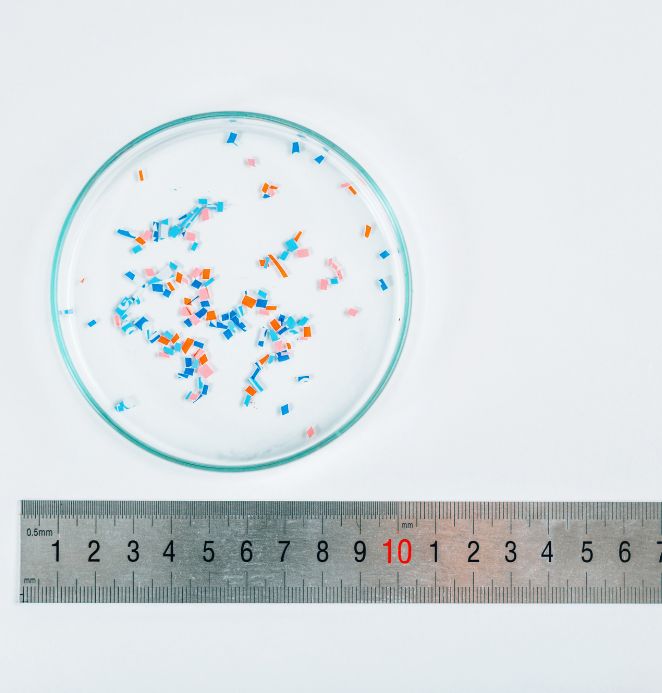
Why is microplastics
analysis neccesary?
Microplastics are a group of synthetic materials that are made from petroleum-derived or bio-based polymers.
They are tiny solid particles, less than 5 millimeters in size, which are not soluble in water and whose degradability is low.
They originate from the fragmentation of larger plastic objects or are manufactured on a microscopic scale into products such as cosmetics and textiles. Its analysis is necessary for the following reasons:
- Impact on marine life
- Human health risks
- Long-term ecological effects
- Pollution assessment
- Interaction with chemical contaminants
- Development of management policies
Regulatory Framework
2024 – Delegated Decision (EU) 2024/1441, supplementing Directive (EU) 2020/2184 of the European Parliament and of the Council by establishing an official methodology for the detection, identification and quantification of microplastics in drinking water.
– 2024 – Directive (EU) 2024/3019 on the treatment of urban waste water incorporates the monitoring of microplastics in the treatment of waste water and sludge.
– 2025 – Directive (EU) on soil monitoring and resilience: already introduces the monitoring of microplastics.
Our analytical methods
The laboratories at Eurofins Environment Testing Spain use advanced analytical techniques to accurately characterise microplastics. They employ three main analytical techniques:
Thermo-Desorption Gas Chromatography Mass Spectrometry (TD/GC/MS)
Thermo-desorption gas chromatography-mass spectrometry (TD/GC/MS) is an analytical technique used to identify and quantify microplastics through thermal desorption of the sample.
In this method, the sample is heated in a controlled manner to approximately 300 °C, causing the release of the thermal degradation products characteristic of each polymer.
These volatile compounds are then fed into a gas chromatography-mass spectrometry system, where they are separated and analysed to determine the type and quantity of microplastics present.
Pyrolysis analysis using Py-GC/MS
Pyrolysis gas chromatography–mass spectrometry (Py-GC/MS) is a widely used analytical technique for identifying microplastics through the controlled pyrolysis of the sample.
In this method, the sample is rapidly heated to around 600 °C, causing the polymers to break down thermally and producing degradation products characteristic of each type of plastic.
These compounds are introduced into a gas chromatography–mass spectrometry system, where they are separated and analysed to determine the polymer composition and the quantity of microplastics present.
Quantum Cascade Laser Infrared Spectroscopy
(QCL-IR)
Quantum Cascade Laser Infrared Spectroscopy (QCL-IR) is an advanced chemical analysis technique that enables the generation of high-resolution chemical maps by combining microscopy with infrared spectroscopy.
Using a quantum cascade laser, this method produces accurate IR spectra at every point in the sample, facilitating the identification and spatial distribution of microplastics and other compounds.
This method is applicable to the analysis of drinking water and complies with the requirements set out in Directive 2020/2184, which regulates the quality of water intended for human consumption in the European Union.
Samples we analyse
Eurofins Environment Testing Spain is equipped to analyse a wide range of samples for microplastics. Some of the samples we process include:
Water
- Drinking water.
- Inland waters.
- Wastewater.
- Marine waters.
Solids
- Sludge.
- Soil.
- Sediments.
- Biota.
Air
R+D: µNanocare Project
At Eurofins Environment Testing Spain we are always committed to innovation. This is where µNanocare was born, a project that is part of the Spanish programme ‘Collaboration Challenges’ 2019, in which we work in collaboration with the Castellonense Agricultural Development Society, FACSA and the IMDEA Water Foundation.
The aim of the μNanocare project is to quantify the presence of microplastics in reclaimed water and agricultural systems. An initiative to improve wastewater treatment systems.
What makes our laboratories stand out?
Maximum range
We have a network of environmental laboratories distributed throughout the national territory, which makes us a benchmark supplier in terms of environmental analysis. In addition, we have maximum scope at the level of accredited parameters and environmental matrices, which allows us to cover all types of sectors and areas.
Guaranteed terms
Dealing directly with our customers is our “hallmark”. We work daily to offer you the highest quality in our service and therefore, one of our main goals is to rigorously comply with delivery deadlines. In addition, we provide our customers with individualized responses to emergencies, unforeseen events or specific requirements so that they always have the most efficient response possible.
Highest quality of service
Each batch of results will be accompanied by positive and negative checks. During extraction and cleaning, particles of different sizes are recovered from reference materials of different plastics.
All analyses are carried out in a positive pressure laboratory, always using good practices to reduce or eliminate background impurities.
Innovation and digitalization
Our laboratories provide their customers with extensive equipment, equipped with the latest technologies on the market and the experience of their staff for the development of new test methods. Innovation and technology are two hallmarks of Eurofins Environment Testing Spain. All our results are digitized so that the client can consult them in real time online.
Our Accreditations
We have a large number of accreditations both by ENAC and by other bodies that allow us to guarantee our clients the maximum reliability and quality of the results.