ISO (International Organisation for Standardisation) standards recognise the need for standardisation of management tools in the environmental field. Among these, ISO 14001 is the benchmark standard for the implementation of an Environmental Management System. This standard sets out the auditable requirements for certification purposes.
What is the ISO 14001 standard?
ISO 14001 certification – Environmental Management Systems (EMS) – is an international standard that enables organisations to demonstrate their commitment to protecting the environment. This commitment is demonstrated through the management of the environmental risks associated with their operations. By assuming this environmental responsibility, organisations not only reduce the environmental impact of their activities but also project and reinforce their image as a sustainable organisation.
ISO 14001 assists in identifying and managing the environmental risks associated with the internal processes of the organisation’s operations. This standard sets out requirements for effective risk management, taking into account prevention and environmental protection, legal compliance and socio-economic needs.
EMS certification to the ISO 14001 standard is an essential tool for companies and organisations seeking to gain greater trust from customers, employees, the local community and society as a whole. This vote of confidence stems from the voluntary demonstration of a commitment to the continuous improvement of environmental performance.
What is it for?
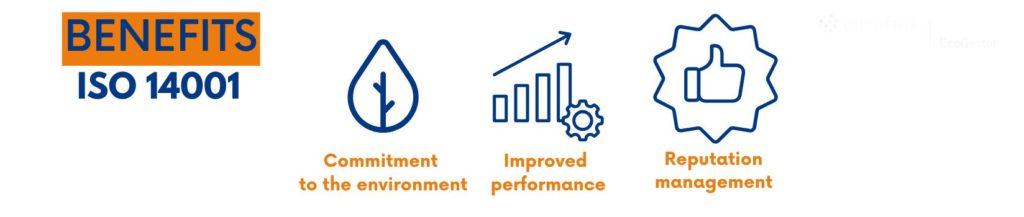
ISO 14001 certification is based on the PDCA (Plan-Do-Check-Act) cycle methodology. It uses familiar management terminology and language, offering a number of benefits to the organisation, in particular:
-
Commitment to the environment
Companies and organisations that seek ISO 14001 certification thereby demonstrate their commitment to sustainable management, ensuring that their performance improves. Incorporating environmental considerations into the organisation’s management and increasing the involvement of senior management and staff in environmental management enables the successful implementation of strategic objectives.
-
Performance improvement
Compliance with ISO 14001:2026 enables the improvement and optimisation of resource management through the rational use of resources. This reduces the likelihood of environmental risks occurring, such as emissions or spills.
By improving process efficiency, costs associated with poor management – such as fines or insurance premiums – are reduced, whilst also benefiting from lower consumption levels.
-
Managing your company’s reputation
By demonstrating high levels of compliance and reducing the risks of non-compliance and the resulting penalties, organisations demonstrate their values and their commitment to the environment. The competitive advantages of an improved image are reflected not only in the external market, but also internally, raising awareness and motivating their staff.
New ISO 14001:2026
The forthcoming ISO 14001:2026, published on 15 April, does not represent a break with established principles, but rather a technical evolution aimed at clarifying and improving understanding of the current requirements. This update seeks to strengthen the effectiveness of environmental management systems and align them with today’s challenges.
The key focus areas of this revision include:
- Integration of Climate Change — Greater emphasis on identifying climate impacts and risks.
- Life Cycle Perspective — Strengthening the consideration of environmental impacts from design through to end of life.
- Change Management — Ensuring that organisational, technological or operational changes are assessed from an environmental perspective.
- Opportunities and Risks — Clarification of how these should be identified, assessed and managed.
- Control of External Supply — Greater precision in the requirements for suppliers and outsourced processes.
This new approach aims to facilitate the practical application of the standard and improve organisations’ ability to anticipate environmental risks and capitalise on opportunities for improvement.
Applicable legislation under ISO 14001
Eurofins EcoGestor is committed to supporting the implementation and maintenance of ISO 14001 certification, assisting with the identification and management of environmental risks associated with your business, as well as subsequent monitoring. The EcoGestor software enables you to access all the documentation and processes associated with the ISO 14001 EMS, ensuring an efficient and beneficial certification process for your company.