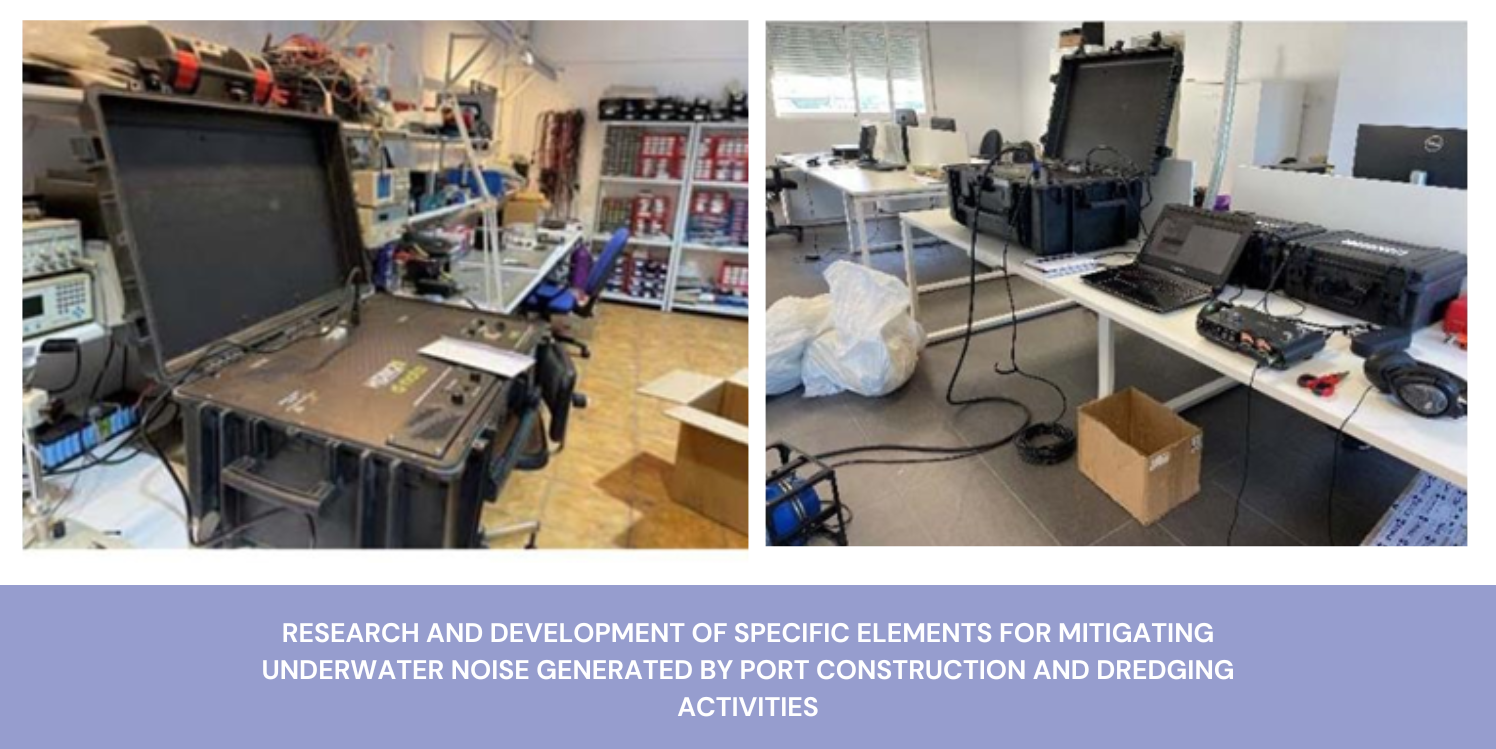
Research and development of specific elements to mitigate underwater noise generated by port works and dredging
Description
In recent years, there has been growing awareness of the pollution of seas and oceans caused by noise generated by human activity. This type of pollution not only disrupts the communication and navigation of marine animals, but recent research indicates that it can even cause habitat abandonment. In this context, the need and motivation for this research stem from the demand expressed by Puertos del Estado and other Spanish port authorities for tools that can reduce and mitigate underwater noise produced during port construction and dredging activities. These needs are outlined in the document Estrategia Marina de la Demarcación Noratlántica, Parte V. Objetivos Ambientales en la Demarcación Marina Noratlántica (2019), which identifies the following priorities:
The following gaps and needs have been identified regarding the study of underwater noise generated during port construction and dredging activities:
To address this need, the general objective that Eurofins aims to achieve is the development of elements capable of providing a complete or partial response to the current knowledge gaps regarding underwater noise in port environments. Accordingly, this research need will be met throught the achievement of the following overarching goals:
TECHNOLOGICAL CHALLENGE AND INNOVATION: The main challenge of the project lies in combining the results obtained from in situ measurement campaigns using a calibrated hydrophone system with Artificial Intelligence. On the one hand, this will make it possible to obtain operational data from field tests and, on the other, through automated data processing, to validate trends, correlations, and causal relationships that allow the estimation of underwater noise attenuation in shallow port and coastal waters, enabling the development of an efficient predictive tool. The development and configuration of a learning tool requires a highly complex knowledge-generation process in new environments, so that models rmain dynamic and can guide designs towards emerging needs. In addition, the design and construction of a scaled prototype requires researchers to assimilate the knowledge gained in previous activities an to thoroughly analyze which elements will be best suited, as well as the existing technologies. For the project to succed and achieve a position in the current market, a comprehensive service package is needed, one that offers a global solution and addresses two key aspects:
- The determination and assessment of underwater noise generated by an activity
- The design and proposal of corrective or mitigation measures.
The most significant development in this research is tackling the callenge of predicting underwater acoustic propagation in environments as complex shallow or port waters—where multiple factors affect sound propagation—using an advanced data-analysis system with Artifical Intelligence tools, calibrated through a hydroacoustic system developed specifically for this purpose. In this regard, AI enables the use of technology to achieve greater transparency in algorithms and models, avoiding behavior manipulation, addressing the impact of work automation, and supporting more acurate and environmentally fair decision-making. It is at this point that the core innovation of the project led by Eurofins Cavendish, S.L. resides, and from which the following technological breakthroughs will emerge: